Nexleaf Analytics
Nexleaf Analytics
Nexleaf Analytics
Nexleaf Analytics
Nexleaf Analytics
Nexleaf Analytics
Overview
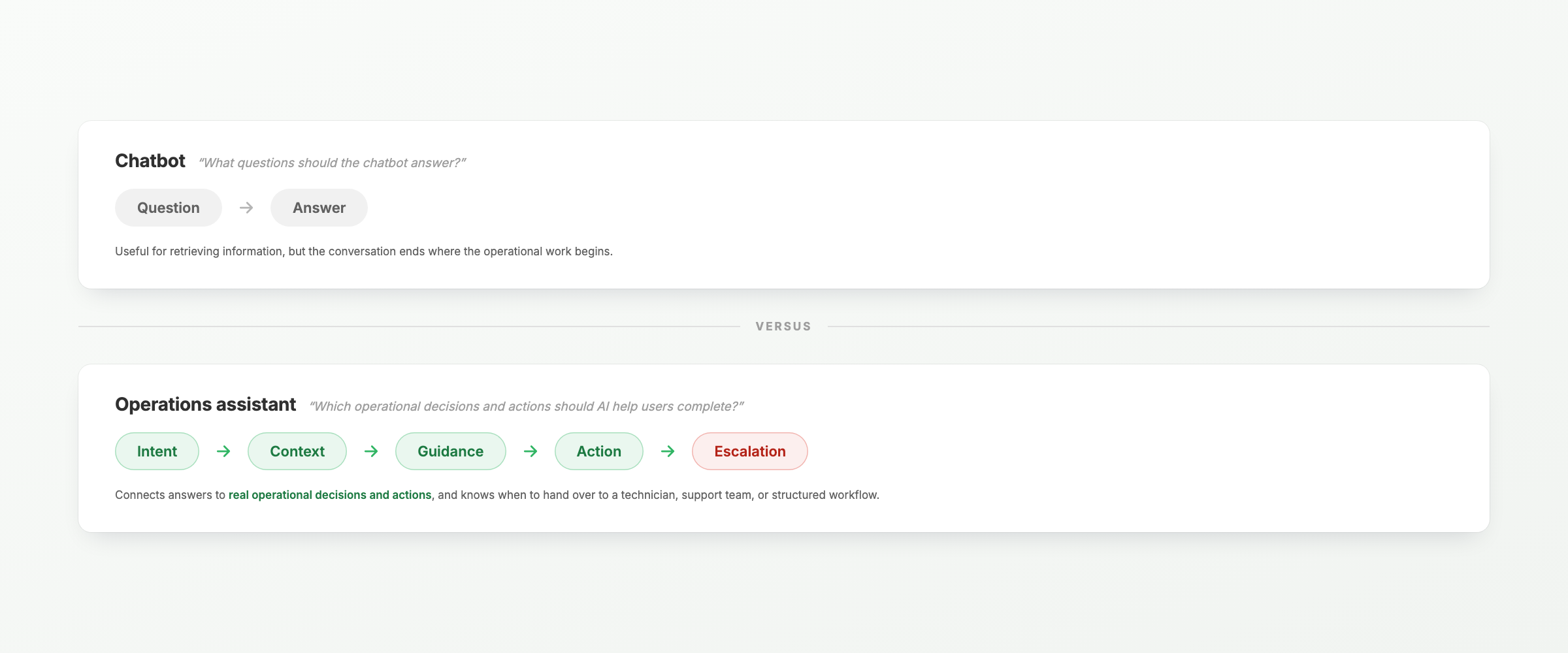
ColdTrace AI began as a question-and-answer chatbot, but the bigger challenge was deciding where AI should sit inside a complex operational product and what it should actually help users do.
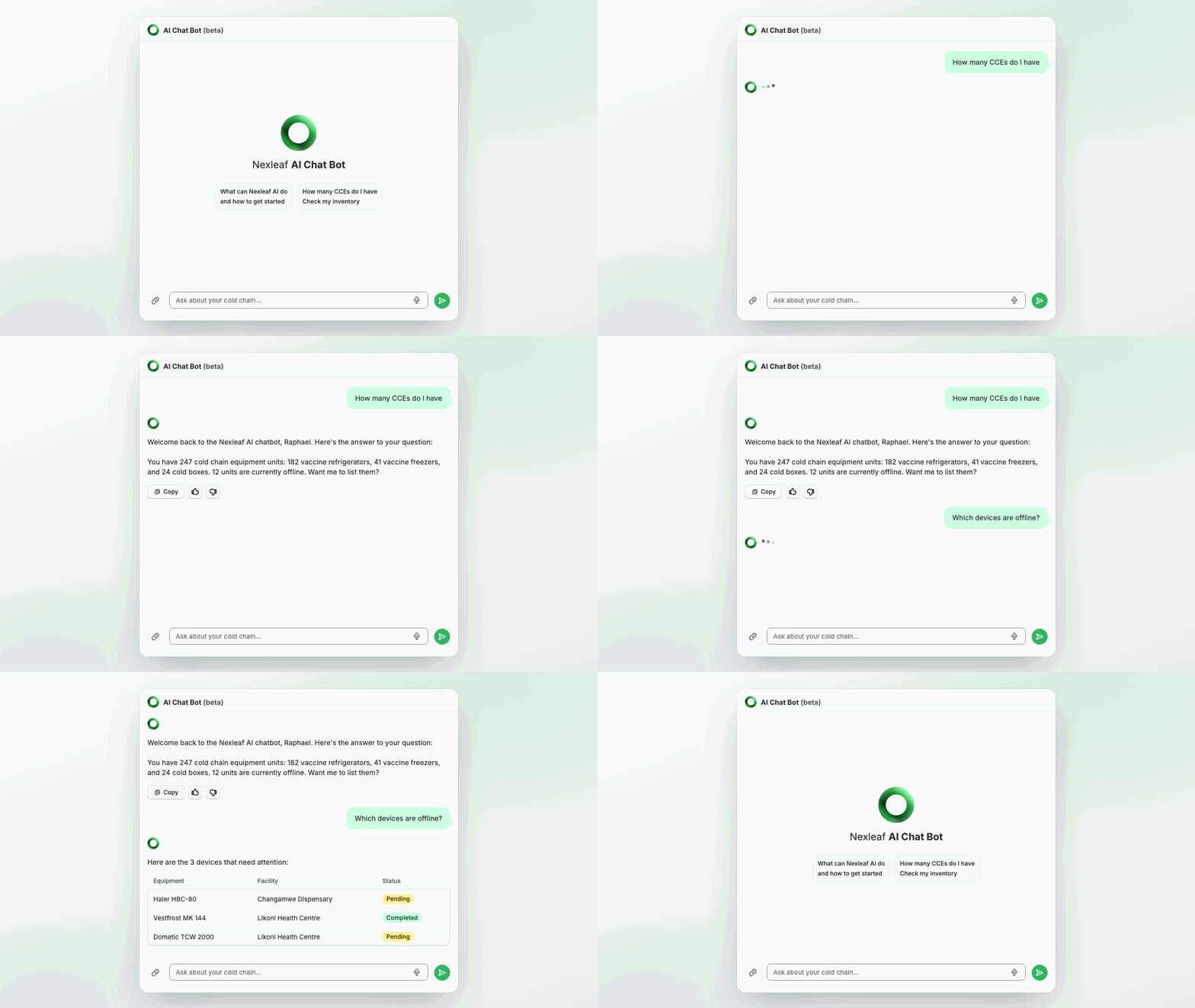
In my first month, I wrote the conversation script, our head of product signed it off, and I built the AI MVP as an end-to-end Figma prototype covering every screen, variation and edge case.
I worked with our Product Manager, business development lead and AI Engineer to map real workflows across equipment monitoring, maintenance, training, service requests and technician support. I helped structure the work around user decisions, available product actions, context and escalation, which shifted the team from thinking about chatbot features to defining an operational assistant. I presented the work to the whole company, and in reviews with our CEO, CTO and the leads of engineering and product.
Research and priorities: I used three sources, so no single one could mislead us: remote sessions with 6 health workers (technicians, nurses and facility staff), device data from our data analyst, and in-house experts. The mapping gave us seven areas where AI could help. I put forward four criteria to choose between them: happens most, highest value, already possible in ColdTrace, and lowest risk. We agreed them as a team, and troubleshooting and service requests came out on top, so we started there.
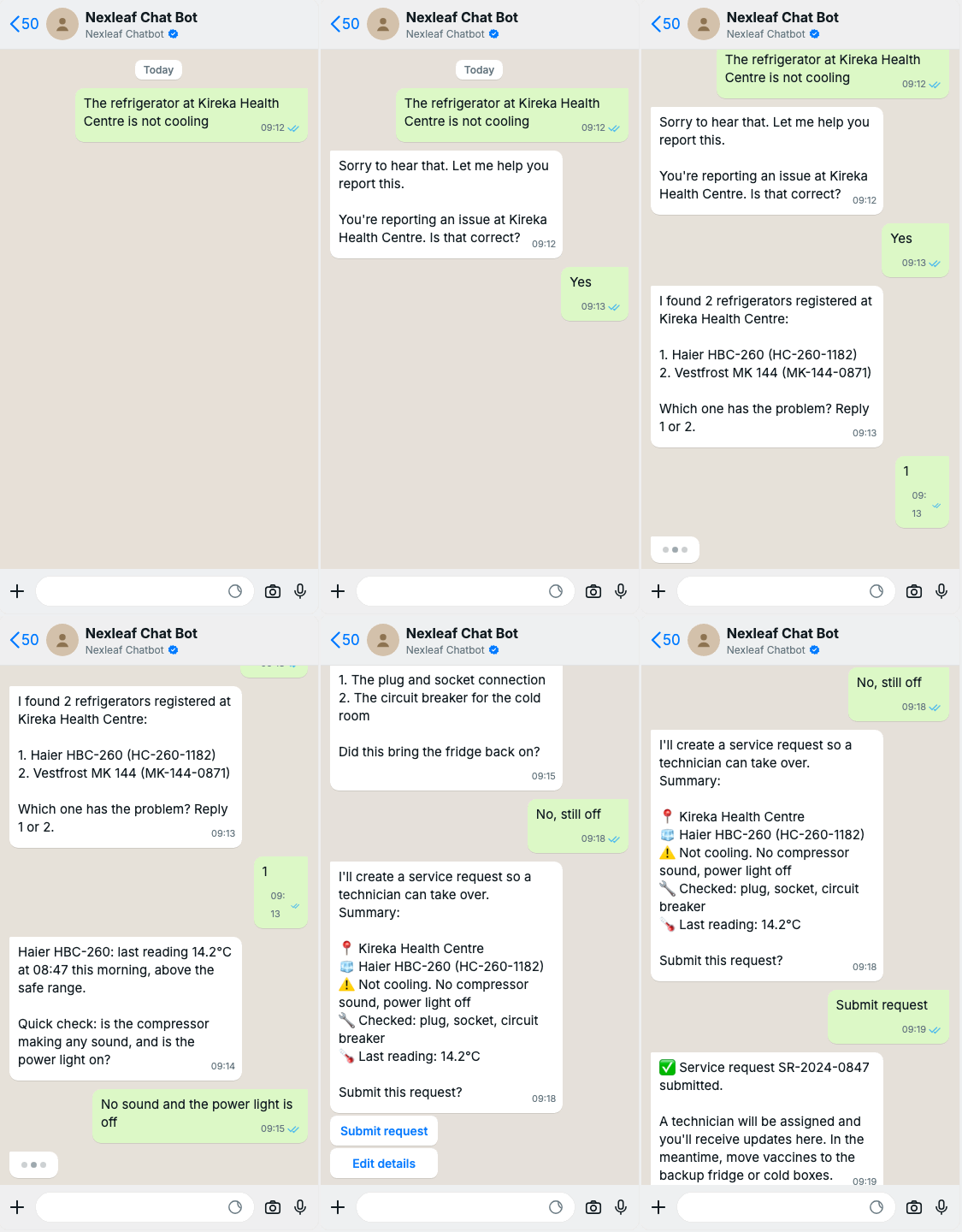
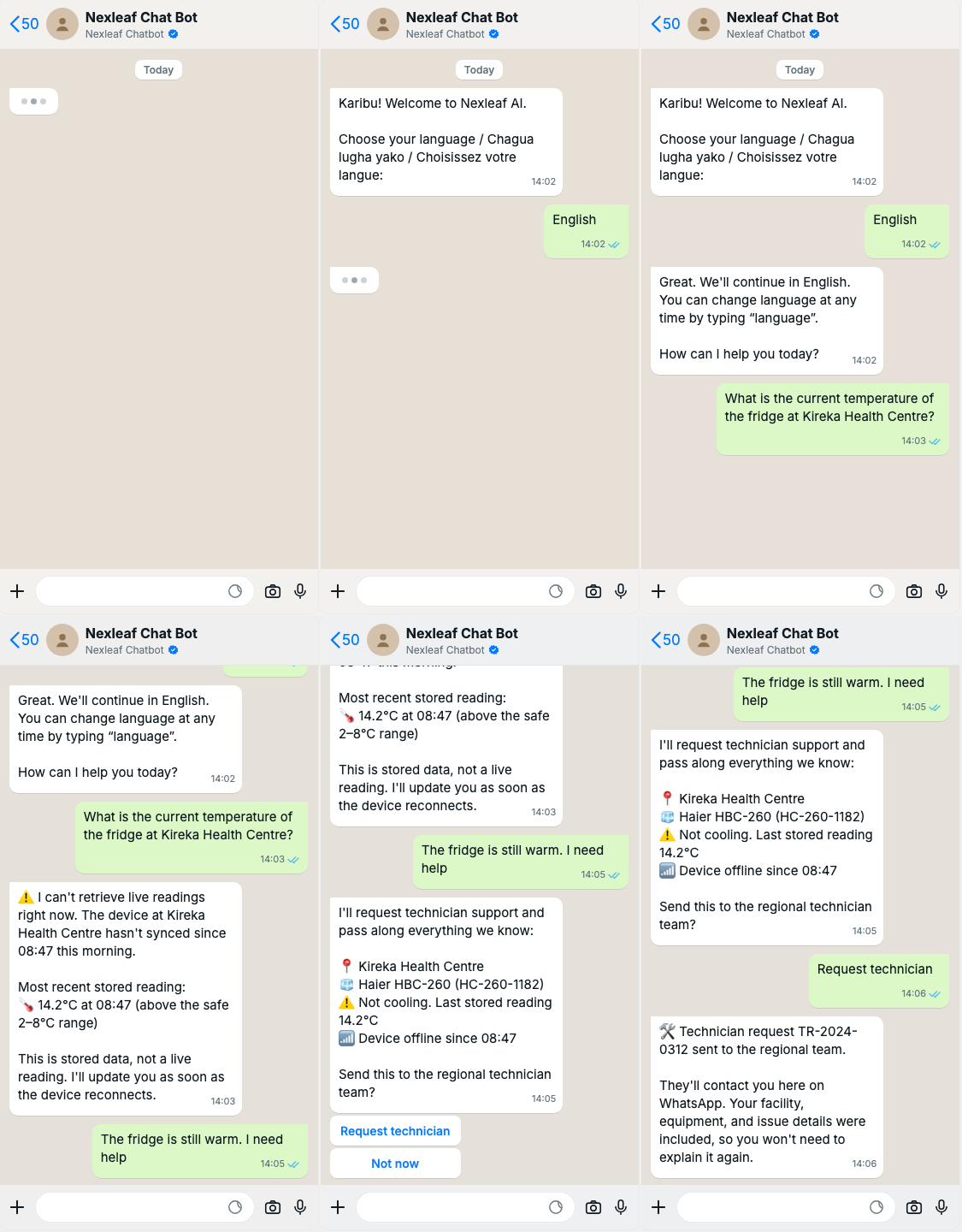
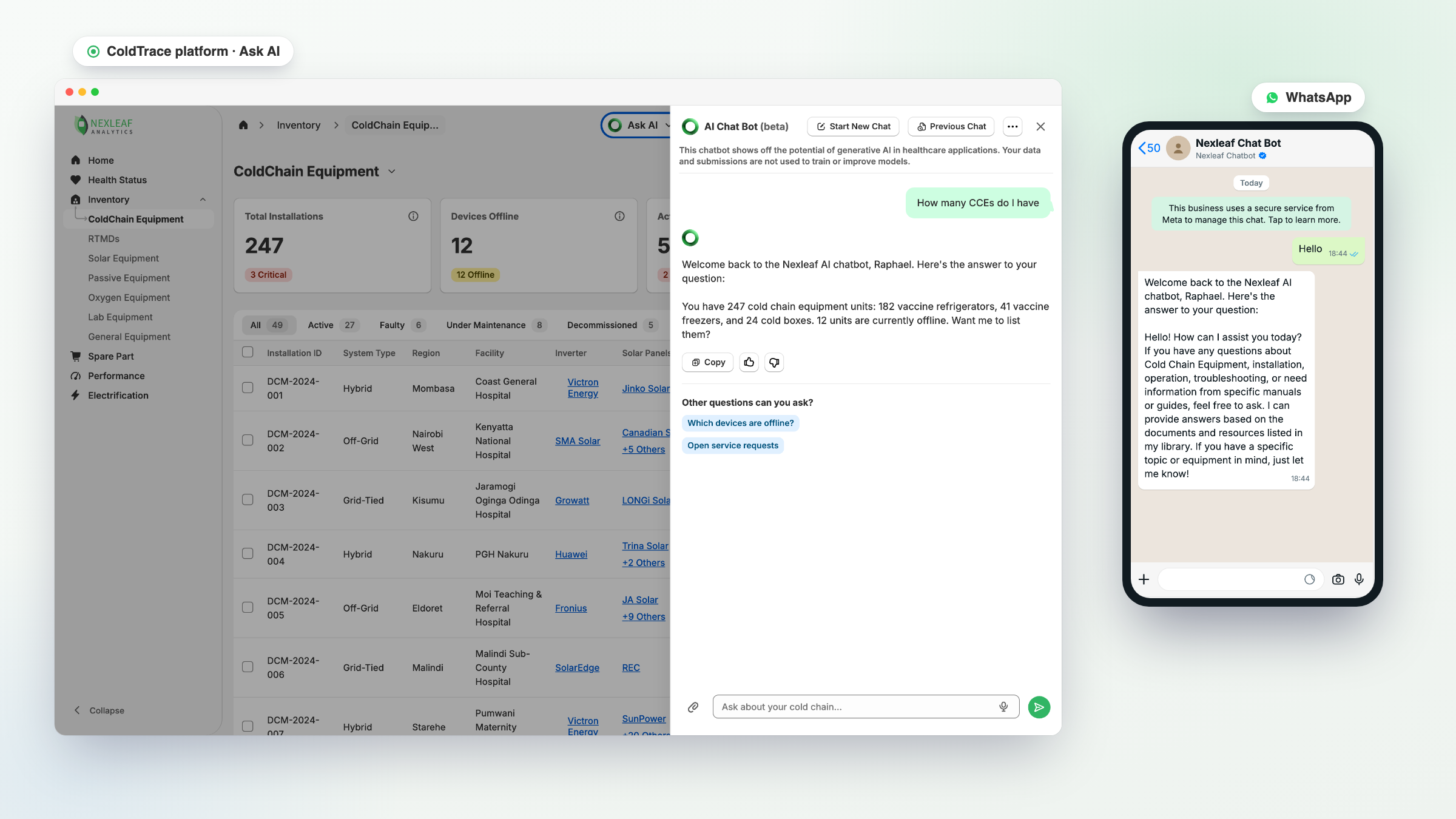
What we learned, and what it changed: technicians work from a phone, by the fridge, often on a weak signal, so WhatsApp handles quick tasks and keeps reports if the signal drops. The answer was usually already in ColdTrace, but people didn’t know where to start, so AI became the way into existing workflows. A blank chat box put the work on the user, so we added guided starters and asked one question at a time. Early guidance used YouTube videos for the wrong device, so we built our own manuals. And at handoff people had to explain everything again, so the handoff now carries the facility, fridge, problem and steps tried.
Options we explored: keep a Q&A chatbot (quick, but nothing gets fixed), put the key ColdTrace workflows all in WhatsApp (it meets people where they are, but reports turn into long chats, and data views and permissions don’t fit in a chat), or build an agent with risk tiers and two channels. We chose the agent.
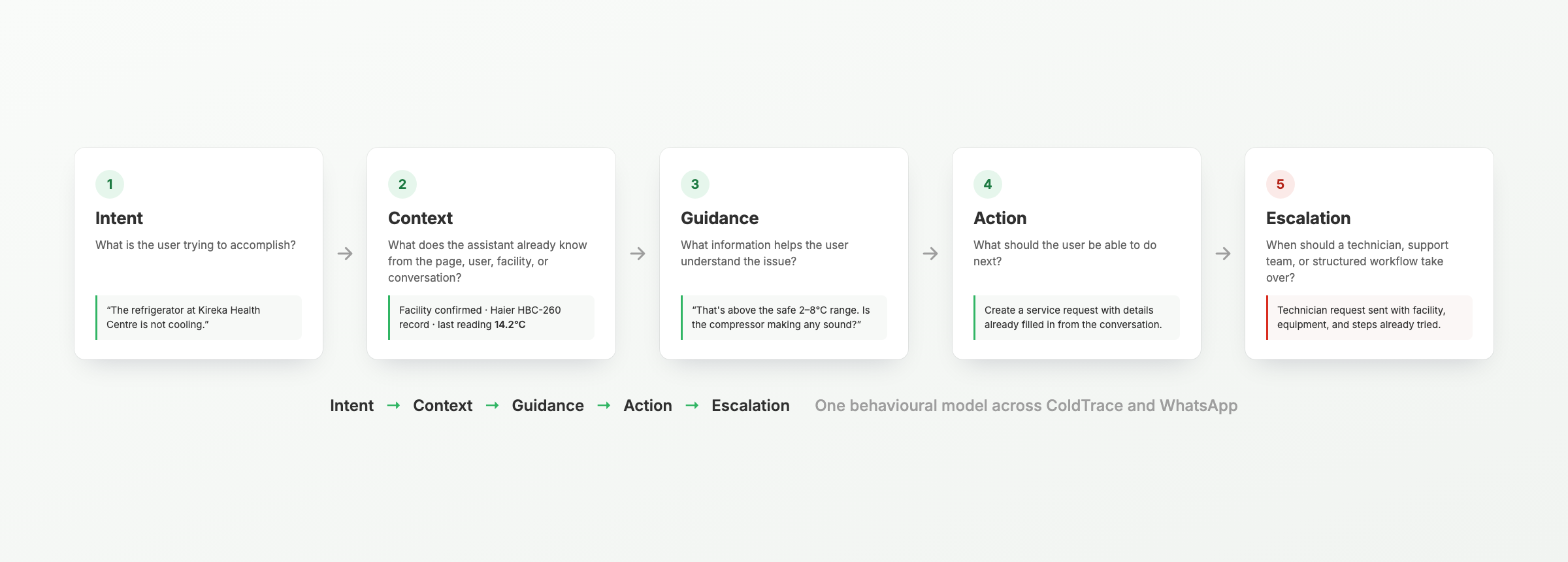
We aligned on a reusable model: intent, context, guidance, action and escalation. The agent first decides whether a message is a question or an action. Actions are gated by risk: read-only tasks run directly, anything that creates a record is summarised and confirmed first, and changes to records hand off to the ColdTrace app, where permissions live. It answers only from our own equipment manuals, and failure states such as missing live data, unclear devices and dropped connections were designed as carefully as the happy path.
Guardrails and evals: our AI Engineer owned the model and retrieval, and I wrote the guardrail spec, eval categories, scenarios and failure states. Every message is checked first: is it harmful, off-topic, trying to change the assistant’s rules, asking it to decide vaccine safety, or asking for data outside the user’s access? Every answer must trace back to a manual or a live reading, and if it isn’t confident enough to name one cause, it says so. I designed an eval set for every release: each guardrail category in every language, pass or fail, plus 15 scenarios through the same decision model.
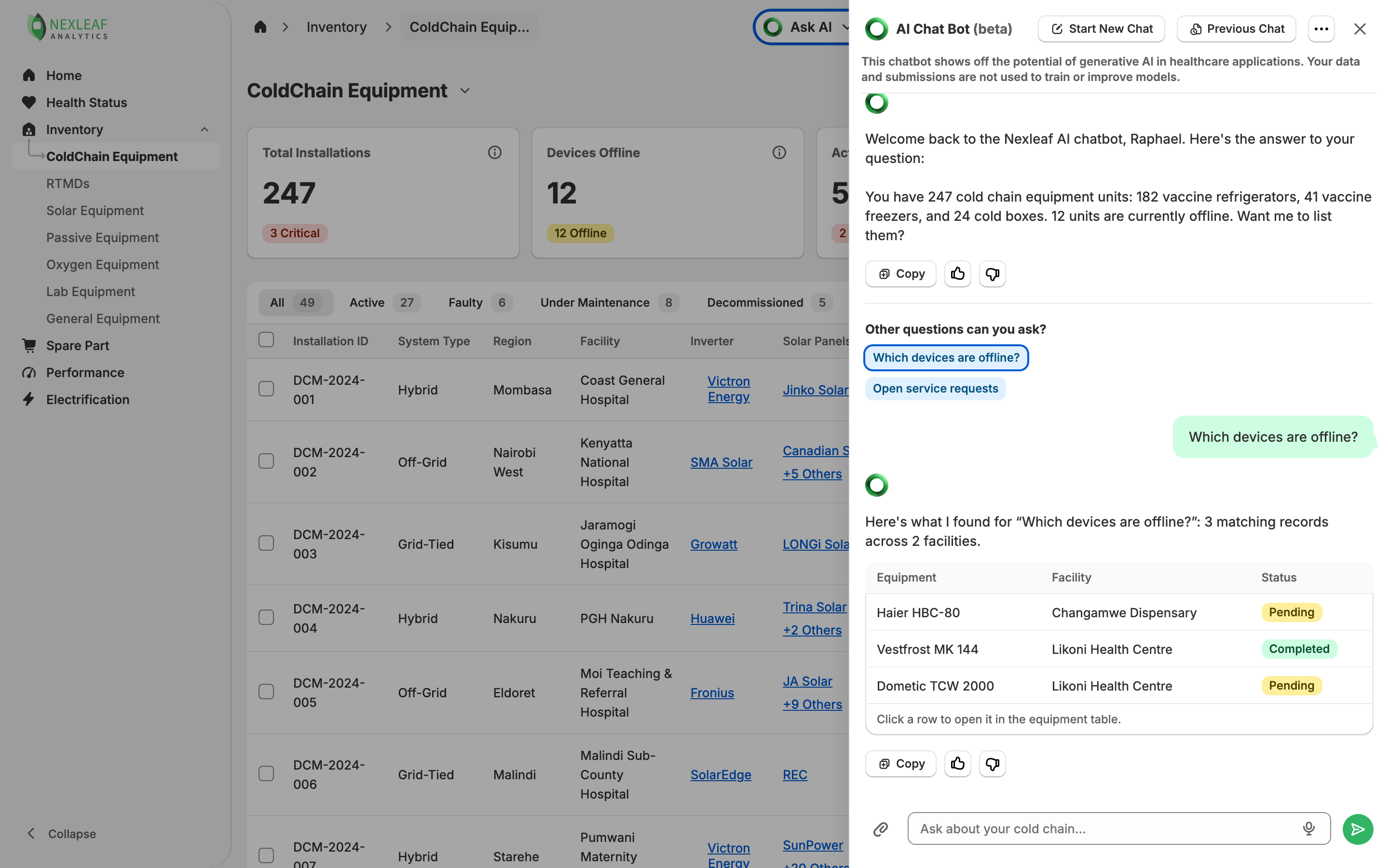
After testing: in the ColdTrace web and mobile apps, the assistant now shows its working as each check runs, every answer ends with guided next actions, and answers collect thumbs-up or thumbs-down feedback. WhatsApp can’t show steps or feedback sheets, so there it sends the answer when ready and uses reply buttons like “Did that work? Yes / No”.
WhatsApp alerts, v1: alongside the agent, I designed version one of moving ColdTrace alerts from SMS to WhatsApp. The trigger was a flood of SMS, over half a million in 30 days, and SMS was expensive at that volume. The data pointed to broken sensors, misconfigured devices and a firmware bug, so v1 builds on that clean-up rather than replacing it. Alerts follow the same idea as the agent: the higher the risk, the stricter the rule. Critical alarms go out straight away, one to one, and repeat every 12 hours, up to 14 times. Smaller issues roll into a digest sent once or twice a day. Nothing is sent without consent, and critical alerts fall back to SMS if WhatsApp fails. The hardest part was a rule conflict: Meta requires that people can stop any message, while ministries need life-safety alarms nobody can switch off. I set out two options for the team, a separate consent for critical alarms or per-alert settings.
Outcome: the assistant is live on the ColdTrace platform and in WhatsApp, launched together with service requests. It launched in 2 countries and is now used daily across 30, with 5,001 health workers connected to Nexleaf AI in the app and on WhatsApp. The work also helped Nexleaf win a $500,000 generative AI grant from the Patrick J. McGovern Foundation in December 2025, for real-time health equipment support. I measure it by resolution first, with escalation, repeat questions and handoff quality as guardrails, not chat volume.